
UN Type expansion joints

These tied custom metal expansion joints are designed to cover the mid temperature and pressure range for general process equipment. These expansion joints are suited for combined and multiple types of movements for general pressure applications. 
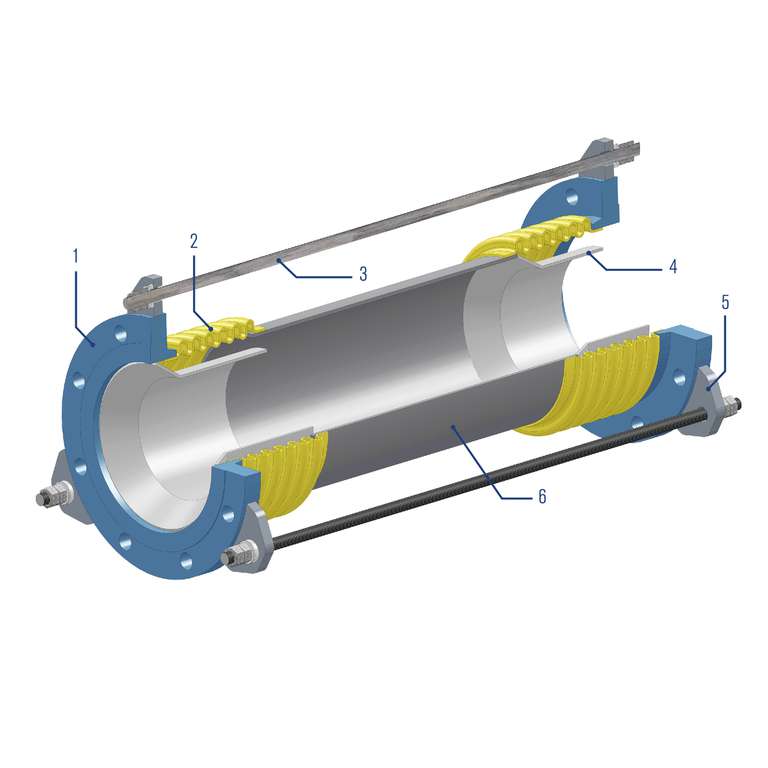
Product Description

Features:
  • (Tied) custom metal expansion joints for general pressure applications.
  • Designed to cover the mid temperature and pressure range for general process equipment.
  • Suited for combined and multiple types of movements.
  • Tied metal expansion joints retain pressure thrust developed by internal pressure, through the use of hardware.
  • Multiply bellows with low spring rate and high cycle life.
Benefits:
  • Covers many applications
  • UN Types does not require anchor points being designed for obtaining pressure thrust, due to the installed hardware.
  • Highly customizable design: Bellows geometry, Material options and combinations.
ITEMDESCRIPTION
1Flange
2Bellows
3Tie rod
4Internal liner
5Lug
6Center spool

Technical Specifications

Operating range:

Diameter: DN 40 ... DN 5,000 (1.5" ... 100”)
Temperature: ... 700 °C (1,292 °F)
Pressure: max. 50 barg (725 PSIG)

Standards and approvals:

Design code:
EJMA 9, PED 97/23/EC according to: EN 13480, EN 13445, EN 14917, AD2000 and ASME B31.3

NDT and documentation:
According to PED 97/23 EC rules and regulations (declaration of conformity).
Documentation can be provided per customer request e.g.:

  • Test, measurement or calculation reports
  • Material test or inspection certificates
  • Design, type or 3rd party approval
Recommended applications:
  • Refining technology
  • Oil and gas industry
  • Power plant technology
  • Pulp and paper industry
  • Shipbuilding
  • Water and waste water technology
  • Gas and steam turbines
  • Conventional boilers
  • Coal feed transport systems
  • Ash transport systems
  • Water cooling systems
  • Air and steam transport lines
  • Compressor / pumping stations
  • Lubrication systems
  • Storage tanks
Notes:

Tied metal expansion joints might require alignment guides to ensure the expansion joint only see the intended movements.